68% Conversion Surge: How Apex Performance Parts Engineered a Perfect Fit
The Compatibility Crisis
Context: For Apex Performance Parts, scaling to $2.5M monthly GMV brought a critical challenge: Compatibility Lifeline: High return rate (18%) due to customers ordering parts that don't fit their specific vehicle models, despite providing vehicle information.
At this stage, standard rules failed. The Automotive enthusiasts and professional modifiers seeking high-performance aftermarket parts for domestic and import vehicles, ranging from hobbyists to professional tuning shops. demanded relevance. Their self-developed system couldn’t handle complex compatibility matrices, leading to frustrated customers returning incompatible parts at an unsustainable rate.
From Self-Built Limitations to AI-Powered Precision
To solve this, Apex Performance Parts deployed WooRec.
Note: Depending on their scale, they leveraged WooRec Private Deployment for the perfect balance of speed and control.
The transformation wasn’t instant. We architected a phased evolution of their recommendation engine:
Phase 1: Expanding the Candidate Pool with Vector Retrieval
Powered by WooRec Strategy Module
We needed to move beyond simple keyword matching. We implemented a Hybrid Recall strategy:
- Foundation: We started by ensuring popular items were visible via Hot Retrieval, solving the Cold Start problem.
- Advanced: Vector Retrieval (Embedding)
- The Logic: We mapped users and items into a high-dimensional vector space using FAISS/Graph Embedding. This allowed us to capture the semantic relationships between vehicle models and parts, going beyond exact Year/Make/Model (YMM) matches.
- The Result: This allowed us to capture “latent interests”—finding items that are semantically related, not just textually similar, which is critical in the automotive domain where parts may have multiple compatible vehicles.
Phase 2: The Model Evolution (LR to DeepFM to ESSM)
Powered by WooRec Model Serving
This is the core of the engine. To achieve the target Conversion Rate, we iterated through three stages:
- The Baseline (Logistic Regression): Initially, we used linear models. While fast, they failed to capture complex feature interactions, such as how a user’s interest in a specific car model might relate to multiple part categories.
- The Upgrade (DeepFM): We introduced Deep Factorization Machines to learn high-order feature interactions, significantly improving accuracy on sparse data. This was crucial for handling the vast and sparse compatibility matrix.
- The Final State (ESSM):
- Why this model?: To solve the CVR estimation bias and balance the goals of CTR (click-through rate) and CVR (conversion rate), we deployed the Entire Space Multi-Task Model (ESSM). This model simultaneously optimizes for both metrics, ensuring that recommendations not only attract clicks but also lead to actual purchases, which directly impacts AOV and LTV.
Phase 3: Traffic Control & Business Logic
Powered by WooRec Rule Engine
Raw scores are just probability predictions. To align with business goals, we applied a Traffic Control Layer:
- Diversity (Scatter/Shuffle): We implemented a sliding window rule—no more than 2 items from the same category in a row—to prevent visual fatigue and encourage exploration of complementary parts.
- Business Injection (Hard Insertion): Specific slots (e.g., Position 4 and 10) were reserved for
Apex Performance Parts’ strategic partners or high-margin house brands, ensuring business priorities are met. - Dynamic Weighting: We boosted items based on Inventory Depth, ensuring that the AI recommends parts that are in stock and ready to ship, thus improving fulfillment times and customer satisfaction.
The Seamless Frontend Experience
Here is how these intelligent recommendations appear on the Apex Performance Parts storefront:
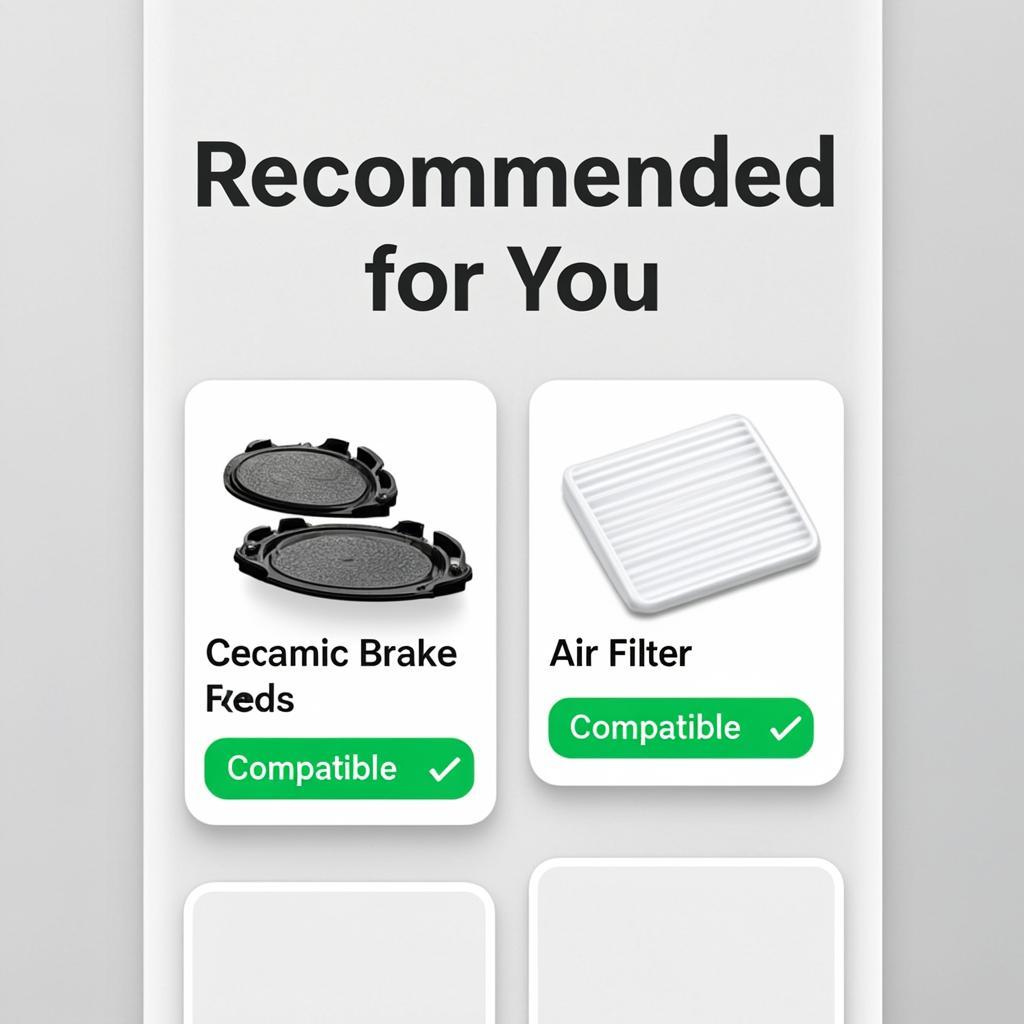 *Figure 1: The result of WooRec's engine—hyper-relevant product recommendations displayed to the user.*
The Impact: 68% Conversion Surge
The speed of deployment meant faster results. By toggling on these strategies, Apex Performance Parts achieved:
- Return Rate Due to Incompatibility: Decreased by 66.7% (from 18% to 6%).
- Average Order Value: Increased by 30% (from $250 to $325).
- Conversion Rate: Increased by 68% (from 2.5% to 4.2%).
- Customer Lifetime Value: Increased by 58.8% (from $850 to $1350).
- Inventory Turnover: Increased by 61.9% (from 4.2 to 6.8).
Customer Voice
“Moving from manual rules to ESSM was a turning point. The system now balances user intent with our business inventory logic perfectly. The 68% lift in Conversion Rate speaks for itself.” — Jessica Chen, Lead Data Scientist at
Apex Performance Parts
Ready to Configure Your Growth?
You don’t need a team of data scientists to build a world-class recommendation engine. With WooRec, it’s just a matter of configuration.